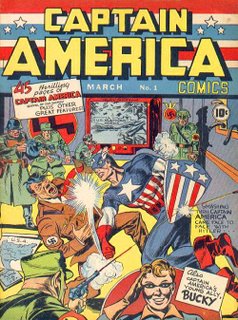
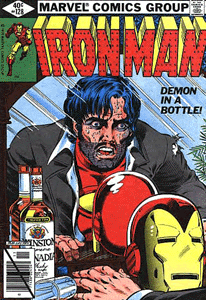
First off, I heartily suggest that anyone interested in supers gaming ought to read
RPG Pundit's post yesterday and the comments following. Now, on to the post.
One of my incomplete game projects right now is
Home Team, a Marvel Universe superhero game. The basic concept is that the PCs are the primary defenders of Manhattan while all the big names in early 80's Marvel comics are off fighting the
Secret Wars. I really liked that concept, as it allows me to bring a lot of third rate Marvel villains out of the wood work. (The campaign is set a couple years before Scourge starts offing guys like Turner D. Century.) I like the PCs, being especially enamored of The Dingo, the character whose premise is "What if baby Kal-El's rocket landed in Australia?" (That's exactly the sort of question no one ever needed to ask but the answer is pretty funny to see in play.) And the player group is tight. Don, Sue, John, Paul, and I have been gaming on and off together for over a decade now. They're pretty dang cool people to game with. Lately I haven't been getting together with that group as much as I used to, and one of the reasons I want to do this campaign is to remedy that situation.
But the campaigns has flaws. I might call the whole project a failure if it weren't for the fact that the players are enjoying themselves enough that I get emails from them asking me to schedule the next session. I've been dodging the next session for a while because I first wanted to get a handle on why I see this campaign as a train almost ready to derail. At first I was looking for the One Big Issue, the resolution of which would turn the game golden. But now I realize that at least three things are wrong with the campaign.
First, there's the system. We started out using an old copy of Palladium's
Heroes Unlimited. Randomly generating the characters was a hoot, but the combat system left much to be desired. Later in the campaign, at my suggestion, we converted the HU characters to
Mutants & Masterminds. M&M is a great set of mechanics, but I had the same basic problem with it as I currently have with D&D 3.5: making bad guys that are properly balanced against the heroes is a lot of work. And I'm not entirely convinced that a direct descendant of the D&D combat system can ever really capture the awesome-osity of a good superhero throwdown. But having switched systems once already, I am hesitant to ask the players to switch again.
And what do I switch to, anyway? Part of me wants to go back to where I started in supers gaming: the old FASERIP version of Marvel from the 80's. That would give me some great advantages. I have a ton of characters for my setting already statted out. MHAC7
Concrete Jungle alone gives me a campaign worth of bad guys. And the system is so easy that even though I haven't played it for almost 20 years I can still make characters with hardly a glance at the rulebook. The downside is that at least some of my fondness for this game has got to be nostalgia. What if we start using FASERIP and it turns out to suck? Do we switch again? I can barely contenance a second conversion, I can't bear the thought of switching systems a third time.
The two other systems that I have been looking at are Mikko Kauppinen's
Powergame and Chad Underkoffler's
Truth & Justice. Internet freebie
Powergame is a close relative to
Marvel Super Heroes, basically substituting small d6 dicepools for the big coloful percentile chart that powers MSH. I wanted to try it for several years now. I haven't seen the insides of a copy of
Truth & Justice yet, but a lot of very smart people are saying credible things about it. I haven't bought a copy because I bought every other super game that seemed to hold out hope for rocking. And here I am, 2 decades and God knows how much money later, still talking about
Marvel friggin'
Super Heros. Maybe T&J will be different. A lot of people are saying it's a game for the FASERIP fan. So I hold out a glimmer of hope.
And system is only one problem with the campaign. Another problem is that the NPC cast is woefully under-developed. Sure, there have been plenty of villains to punch, but there's been no Jarvis or J. Jonah Jameson. What little cast we've used needs to be properly fleshed out. And the PCs need their own unique NPCs. In the earliest posts on his comics blog, Scipio of
The Absorbascon makes a convincing argument that the greatest superheroes achieve depth through the strength of their supporting casts. He calls the concept the
Dynastic Centerpiece, wherein you build a cast around the hero. One of the reasons the iconic Justice League (Superman, Batman, Wonder Woman, Flash, Green Lantern, the Professor, and Mary Anne) possesses so much gravitas is because so many of the characters come to the table with their own storied past. Giving each PC in my campaign something like their own dynasty would go a long way towards achieving that effect. And it would give each PC more to do besides running around stopping rampaging villains and performing missions for Nick Fury. Superhero comics aren't all about ridiculous urban fisticuffs, there's also the ridiculous soap opera portion. And my campaign has been seriously lacking in the latter.
These first two concerns are fixable. Switching systems sounds awfully painful, but can be done. Heck, if we switched to Marvel I could do 90% of the PC conversion in my head. It's not the mechanical crunchery that worries me, rather I find it appalling rude to ask my players to adapt to new system, again. But my third problem is much harder to solve and still retain the Home Team game:
I no longer enjoy GMing a game set in someone else's comic continuity. When I started this project I looked forward to playing in the sandbox of the comics I grew up reading. But whatever bug was in my system when I started this project seems to be gone. If I do another supers game I want to start from scratch, with no expectations that come from working with an established universe. But to take the Marvel out of Home Team is to rob the campaign of its identity. I don't see a solution, other than simply quit while we're behind or to tough out a few more sessions of campaign I'm not digging in hopes of bringing some sort of closure to the lives of Radar Man, Cyborg, the Dingo, and Jill Montgomery: Agent of SHIELD. And if I choose to try to see this project to the end, do we try to cram some more NPCs in? Do we switch systems for a few sessions? Would it do any good to follow through on these ideas, knowing that the GM isn't fully committed to the campaign? Maybe fixing the mechanical and structural issues of the campaign will be enough for me to be more enthused about running some sessions. Or maybe it will be much effort expended only to see the game fizzle out.
Even with that third concern, I'd still like to find a way to become re-energized about the campaign and play out the rest of the planned "12-Issue Limited Series". It may be that one of the reasons I don't have that energy level is because I spend so much of my free moments prepping for my current D&D campaign. Perhaps the solution is as simple as re-approaching this problem after the
Wild Times game ends. Trying to solve this problem and run an ongoing, high-level D&D game may just be too much for my brain to handle.
I don't think any of the players of the campaign are regular readers of my blog, but I'm going to e-mail them a link here. Hopefully they'll post some comments or e-mail me a response. I want to hear what they have to say about these things. I've been letting this campaign hang over me like a dark cloud for a while now, but I needed to sit down and type out the problems in order to really see what's been bugging me.
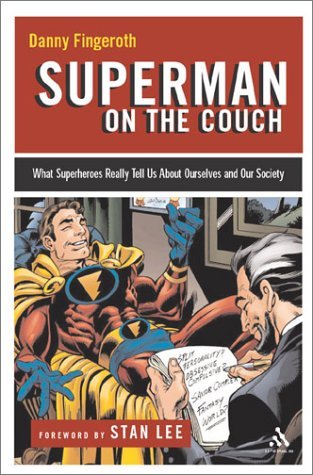 I enjoyed Danny Fingeroth's Superman on the Couch, but I'm not sure how much I really learned from it. I got the impression that Fingeroth was writing to a more general audience. Superman on the Couch does a good job of explicating the underlying premises of our most beloved comic icons. But the results of these explorations end up looking completely obvious to me. This leaves me with the impression that Superman and Spider-Man are really just as shallow as many people suspect. That doesn't bother me much, but I bet that conclusion wasn't the one Mr. Fingeroth was hoping I'd reach.
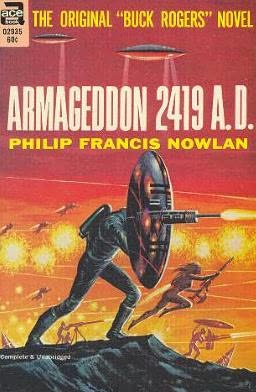 outer space. Nonetheless it was a nifty adventure yarn, albeit lacking in the sturm und drang I like in my sci-fi. The violence is described in an almost clinical fashion, the first person 'memoir' narration is often detached from the emotional impact of each scene, and Anthony and Wilma Deering's courtship is so chaste you'd think June Cleaver was the author.